


The best New York dedicated server hosting depends on what you need to protect or speed up. InterServer suits buyers who want balanced pricing. ReliableSite and Sharktech suit buyers who care most about DDoS protection. GTHost fits anyone who needs an instant 10 Gbps server. Clouvider fits teams that want an SLA in writing, and Contabo gives you the most hardware per dollar. Hosting.com offers phone support and a refund window, and Kamatera fits you if you want cloud flexibility instead of bare metal. A good pick has a New York facility, current hardware, built-in DDoS mitigation, and terms that match how long you plan to keep the server.
Choosing is hard because listings blur together. Every provider promises "low latency" and "enterprise-grade" infrastructure. Meanwhile, prices for similar hardware differ by more than $100 a month, and some products sold as dedicated are really cloud instances. If you compare the wrong things, you either overpay or end up with a server that cannot handle your traffic.
This guide gives you the criteria first, then a side-by-side table and a worked cost example. After that come eight providers, each judged on the same three points: what you get, who it suits, and pricing and terms. The figures come from each provider's published plans, so confirm current prices and the New York location at checkout. We also run dedicated servers at LeapDigitals, which shapes what we think matters, and we say so at the end.
How to compare New York dedicated server providers
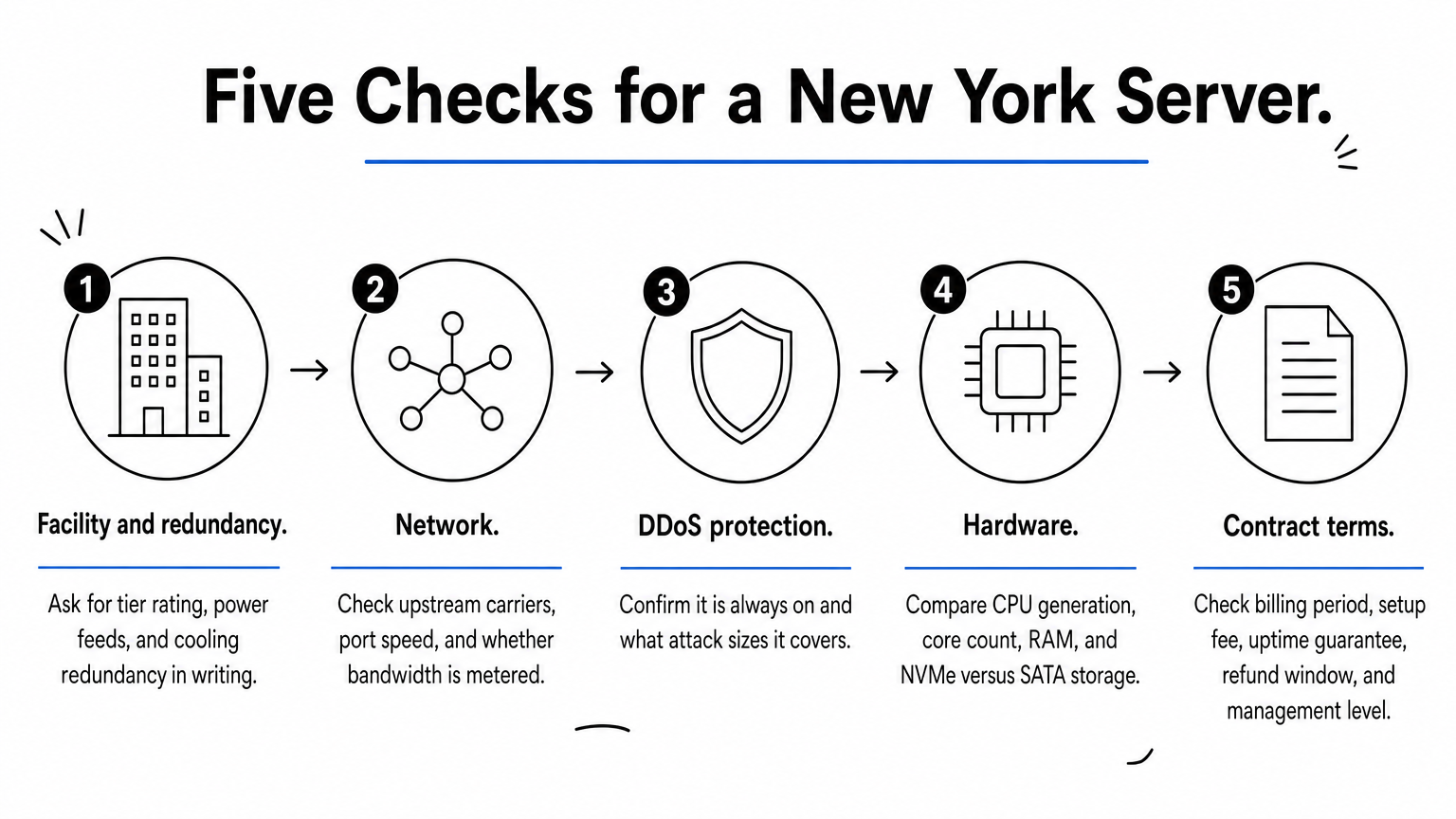
Compare providers on five checks: the facility, the network, DDoS protection, the hardware, and the contract terms. Price only means something once those five are equal. A $160 server with weak support and a $280 server with an SLA are not the same product.
The five checks that matter
Start with where the server actually sits. Some providers sell "New York" plans from a nearby state. Ashburn, Virginia is a common example, and it sits roughly 200 miles from the city. Confirm the data center is in the New York metro area if your users or trading counterparties are there.
Then look at distance, because it sets a floor on latency. Light in fiber covers about 124 miles per millisecond, so a round trip from New York to Los Angeles cannot take less than roughly 40 ms. Real routes add more. A New York server serves the East Coast very well and the West Coast acceptably. Users in other regions may need a second server closer to them.
- Facility and redundancy: ask for the tier rating, power feeds, and cooling redundancy in writing.
- Network: look for multiple upstream carriers, the port speed (1 Gbps or 10 Gbps), and whether bandwidth is metered.
- DDoS protection: ask whether it is always on and what attack sizes it covers.
- Hardware: check the CPU generation, core count, RAM, and NVMe versus SATA storage.
- Terms: check the billing period, setup fee, uptime guarantee, refund window, and whether the server is managed or unmanaged.
A New York address only helps if the data center, the network and the contract all hold up.
Side-by-side comparison
The table shows what each provider's published plans and pages state. "Plan page" means the provider's New York page did not give a fixed price, so you configure or request a quote.
| Provider | Best for | Standout fact | Listed price signal |
|---|---|---|---|
| InterServer | Balanced value | Free DDoS protection, 99.9% uptime guarantee | $167 to $182/mo (Ryzen) |
| ReliableSite | Redundancy | Tier 4 facility claim, N+2, free DDoS protection | Plan page |
| Clouvider | SLA-focused buyers | 100% SLA advertised | Plan page |
| GTHost | Fast deployment | 10 Gbps, 15-minute delivery, no setup fee | Plan page |
| Sharktech | Attack-prone sites | Built-in DDoS protection | $259 to $299/mo |
| Hosting.com | Support, refund window | 30-day money-back, in-house 24/7 support | $189 to $469/mo |
| Contabo | Raw specs per dollar | Always-on DDoS protection | $161.10 to $431.10/mo |
| Kamatera | Cloud flexibility | 30-day trial with $100 credit | From $19/mo |
A worked cost example
Take a typical mid-size workload: a database and application server with 12 cores and 64 GB of RAM. Contabo lists an AMD Ryzen 12-core server with 64 GB of RAM and 1 TB of storage at $161.10 a month. Hosting.com lists a 12-core, 64 GB plan at $279.00 a month. Over 12 months that is $1,933.20 versus $3,348.00, a gap of $1,414.80.
That gap is not automatically waste. Hosting.com's price includes in-house phone support and a 30-day refund window, while Contabo's lower price assumes you handle more yourself. Decide what a support call is worth to your team before you decide the cheaper server wins.
1. InterServer
InterServer is the most balanced pick on this list. It offers New York metro dedicated servers with strong specs, free DDoS protection, and a reputation for fair pricing.
What you get
InterServer sells single-tenant servers with full root access and a choice of Linux or Windows. It includes free DDoS protection and lists a 99.9% uptime guarantee. Support runs 24/7 by chat, phone, and ticket. Its listed Ryzen servers are:
- AMD Ryzen 5600X: 6 cores, 128 GB RAM, 2 TB storage, $167/mo
- AMD Ryzen 5950X: 16 cores, 64 GB RAM, 2 TB storage, $174/mo
- AMD Ryzen 5900X: 12 cores, 128 GB RAM, 2 TB storage, $182/mo
Who it suits
InterServer suits developers and small teams that want many cores and plenty of RAM without paying enterprise rates. If you run databases, game servers, or a busy WordPress or Magento store, the 5900X with 128 GB is a strong starting point.
Be honest about the trade-off. These are unmanaged-style servers where you handle the operating system, patching, and hardening yourself. If nobody on your team is comfortable with Linux administration, budget for a managed option elsewhere.
Pricing and terms
At $174 a month, the 16-core 5950X costs $2,088 over 12 months. InterServer's cards on third-party review sites mention a 30-day money-back offer, but confirm whether it covers dedicated servers before you order. Check the setup fee and the bandwidth allowance as well, since both change the true monthly cost.
2. ReliableSite
ReliableSite is the pick when facility redundancy matters more than shaving the monthly price. It advertises a premium New York City metro data center with true N+2 redundancy.
What you get
ReliableSite advertises free DDoS protection on its New York servers and describes its facility as tier 4. N+2 means the site can lose two components, such as cooling units or power modules, and keep running. These are the provider's own claims, so ask for the facility documentation before you rely on them.
Who it suits
It suits payment platforms, SaaS products, and trading-adjacent tools where an hour of downtime costs more than a year of price differences. A redundant facility does not protect you from your own configuration mistakes, so you still need backups and a failover plan.
It is less suited to hobby projects. If your workload can tolerate a reboot now and then, you pay for redundancy you will not use.
Pricing and terms
ReliableSite's New York page does not state a single entry price, so use its configurator or ask for a quote. Before you pay, ask three questions:
- What attack sizes does the free DDoS protection cover?
- Is bandwidth metered, and what happens at the cap?
- What is the notice period for cancellation?
3. Clouvider
Clouvider is worth a close look if you want the strongest uptime promise in writing. Its New York page advertises a 100% SLA and a network-focused data center.
What you get
Clouvider offers dedicated servers in New York City with a 100% SLA and a range of hardware for business workloads. The company is known for its carrier network, so connectivity is its core selling point rather than a side feature.
A 100% SLA is a contract term, not a physical guarantee. Read the document to see what counts as downtime and how the credits work.
Who it suits
Clouvider suits businesses that need a contractual uptime commitment, such as agencies hosting client applications or companies with internal uptime targets. It also fits teams that care about routing quality and want a provider with its own network.
It is a weaker fit for buyers who want to click a plan and pay in two minutes. Expect to configure a server and check availability.
Pricing and terms
Prices on the New York page depend on the configuration you choose. Compare quotes at equal specs against InterServer or Contabo. Then ask Clouvider what service credit you receive per hour of downtime. An SLA with a tiny credit protects you less than the headline number suggests.
4. GTHost
GTHost is the fastest way to get a New York dedicated server. It advertises instant 10 Gbps servers delivered in about 15 minutes, any time of day.
What you get
GTHost lists 10 Gbps dedicated servers in New York, delivery in 15 minutes 24/7, no setup fees, month-to-month billing, and Linux auto-deploy. You pick a server, pay, and install your OS without waiting for a technician.
Who it suits
It suits short-lived and bursty workloads. Think of a launch weekend, a load test, a migration where you need a staging server fast, or a streaming event. You can run the server for a month and cancel without a long contract.
It suits long-term planning less well. If you will keep the server for three years, a provider with discounts for longer terms may cost less.
Pricing and terms
With no setup fee and monthly billing, your minimum commitment is one month. A 10 Gbps port does not mean unlimited traffic, so read the bandwidth terms to see whether the port is metered or unmetered. Compare the monthly price with a longer-term competitor before deciding that flexibility is worth the premium.
5. Sharktech
Sharktech is the pick for sites that attract attacks. It advertises built-in DDoS protection on its dedicated servers and 24/7 technical support.
What you get
Sharktech's listed New York plans use dual-Xeon hardware with built-in DDoS protection and customized configurations. Its listed plans are:
- Dual Xeon E5-2695v4: 36 cores at 2.1 GHz, 64 GB RAM, 2 TB storage, $259 to $269/mo
- Dual Xeon Gold 6248: 40 cores at 2.5 GHz, 128 GB RAM, 2 TB storage, $299/mo
Who it suits
It suits gaming servers, ecommerce sites, and API businesses that get hit by traffic floods and cannot afford to scramble for a scrubbing service. Heavy parallel workloads also run well on 36 to 40 cores.
The catch is clock speed. At 2.1 to 2.5 GHz, single-threaded work such as some PHP or game-tick loops runs slower than on a modern Ryzen. Choose it for protection and parallelism, not for raw per-core speed.
Pricing and terms
At $259 a month, the E5-2695v4 plan costs $3,108 over 12 months, almost double the 5950X on InterServer. You pay the difference for the DDoS posture and the dual-CPU platform. Ask Sharktech how its mitigation behaves during an attack, and whether legitimate traffic stays online.
6. Hosting.com
Hosting.com is the pick for teams that want vendor support and a refund window. It lists a 30-day money-back guarantee and in-house 24/7 support by phone, live chat, and ticket.
What you get
Hosting.com's dedicated servers carry in-house 24/7 support and a 30-day money-back guarantee. Its listed plans are:
- Dedicated 1: 32 GB RAM, 1.88 TB storage, $189/mo
- Dedicated 2: 12 cores, 64 GB RAM, 1.88 TB storage, $279/mo
- Dedicated 3: 16 cores, 128 GB RAM, 1.88 TB storage, $469/mo
Who it suits
It suits small businesses without a full-time sysadmin. When a disk fails or a network port misbehaves at 2 a.m., a support team that answers the phone is worth real money. It also suits buyers who want to try a server and walk away if it disappoints.
It does not suit price-driven buyers. Compared with Contabo or InterServer, you pay a clear premium for the same core and RAM counts.
Pricing and terms
The jump from the 12-core plan at $279 to the 16-core, 128 GB plan at $469 is $190 a month, or $2,280 a year, for four more cores and double the RAM. Check whether that step fits your growth plan, because you may do better adding a second mid-range server. Confirm what the refund covers before you assume setup is included.
7. Contabo
Contabo gives you the most hardware per dollar on this list. Its listed New York plans start at $161.10 a month for a 12-core server with 64 GB of RAM.
What you get
Contabo lists always-on DDoS protection and 24/7 support. Its plans are:
- AMD Ryzen 12 cores: 64 GB RAM, 1 TB storage, $161.10/mo
- AMD Genoa 24 cores: 128 GB RAM, 2 TB storage, $215.10/mo
- AMD Turin 32 cores: 128 GB RAM, 2 TB storage, $431.10/mo
Who it suits
It suits cost-conscious teams with their own admin skills, such as agencies, SaaS startups, and developers moving off a VPS that has become too small. The 24-core Genoa plan at $215.10 is especially good value for parallel workloads.
Support covers setup, migrations, and basic troubleshooting. Kernel tuning, clustering, and unusual software stacks are your job. Expect extras such as additional IPs or backups to raise the monthly bill.
Pricing and terms
The Ryzen plan costs $1,933.20 over 12 months. The jump from the 24-core plan to the 32-core Turin plan is $216 a month for eight extra cores, so test whether your software scales across cores before you pay it. Confirm the New York location is selected at checkout, because Contabo operates in several regions.
8. Kamatera
Kamatera is the only option here that is not a physical dedicated server. It is a cloud platform with a New York data center, and it suits you when you want to test or scale before committing to hardware.
What you get
Kamatera lists a New York data center, a 30-day free trial with $100 credit, and servers you can create in under 60 seconds. Entry configurations start at $19 a month for 2 vCPUs and 4 GB of RAM, and $32 for 8 GB. It publishes 99.95% uptime and 24/7 support by chat, phone, and email.
Who it suits
It suits teams validating New York latency before they sign up for a physical server. It also suits workloads that grow and shrink, because you adjust CPU and RAM instead of migrating hardware. Many buyers use it for a staging environment that mirrors a dedicated production box.
Do not choose it if you need single-tenant hardware for compliance or consistent disk performance. A virtualized server shares physical resources with other tenants.
Pricing and terms
Pricing grows with every resource you add, so a large configuration can cost more than a bare-metal server of the same size. Use the free trial to measure real performance. If the numbers look good, price an equivalent dedicated server from InterServer or Contabo and compare.
Getting your New York server decision made
If you want a safe default, start with InterServer or Contabo for value, add Sharktech or ReliableSite when attacks and uptime drive the decision, and use GTHost or Kamatera to test before you commit. Whatever you choose, confirm the New York location, read the DDoS limits, and check the SLA credit terms in writing.
If you want one account for servers across regions, LeapDigitals offers dedicated servers in its Americas region, alongside Asia and Europe. Product availability varies by region, so ask about your location first. Dedicated server refunds there are limited to verified hardware faults or qualifying downtime, with no change-of-mind refund, so confirm your specs before you order.


